

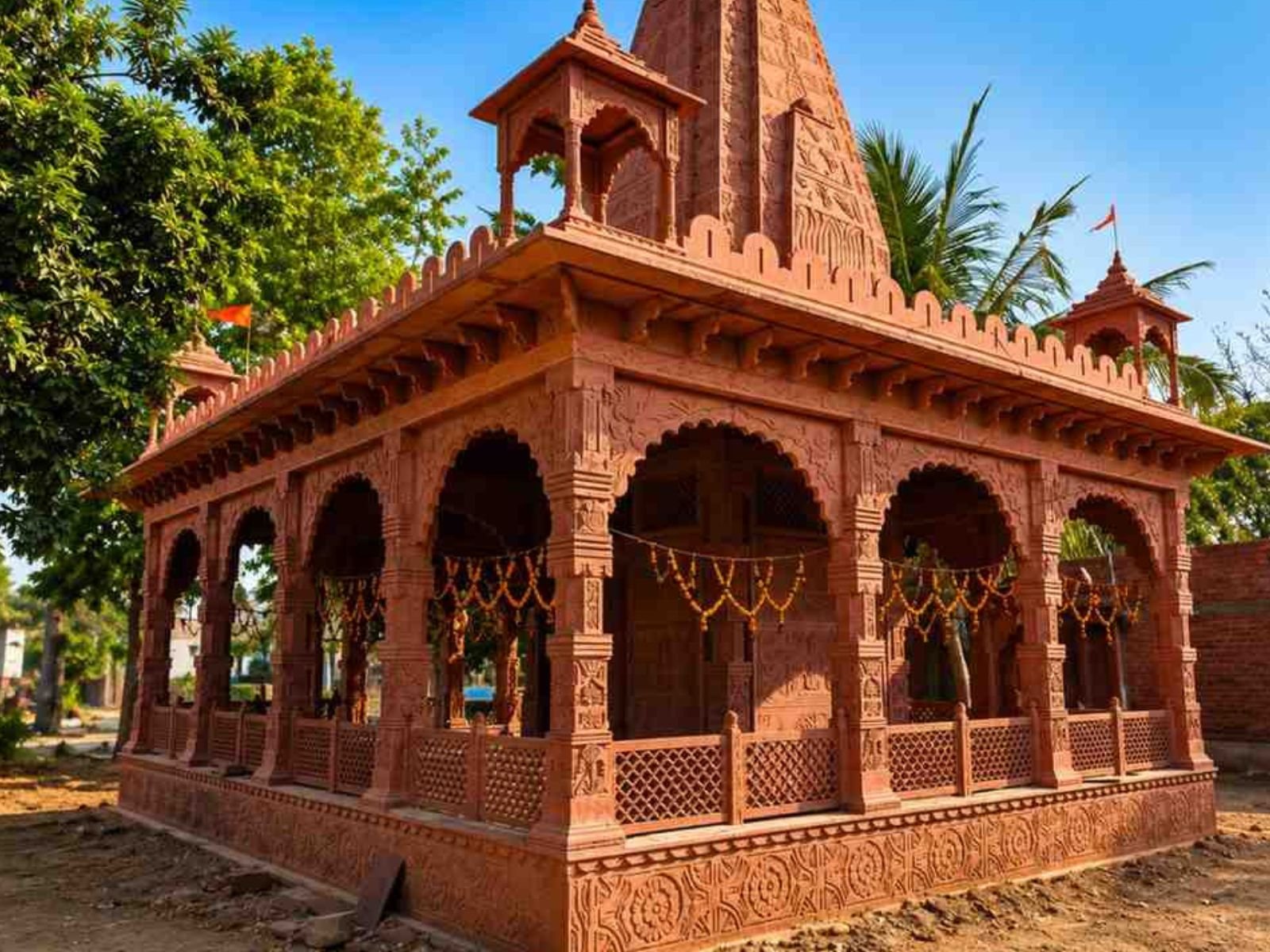
A Red Stone Temple for Home is a hand-carved outdoor mandir built from red sandstone, designed for homes, gardens, and residential or institutional spaces. Shri Krishna Stone Company builds these temples to order, working from reference sizes such as a compact 6-foot Baramda Mandir up to a larger 18 ft x 24 ft Shiv Parivar Mandir, so the same product line can suit a single-family courtyard or a shared society prayer space.
Because each temple is hand-carved rather than mass-produced, the final structure is shaped around the buyer’s site, deity requirements, and design preferences rather than sold as one fixed model.
Product Specifications
| Specification | Details |
|---|---|
| Brand | Shri Krishna Stone Company |
| Contact | 9413746096 |
| Product Name | Red Stone Temple for Home |
| Material | Red Sandstone |
| Sizes Available | Custom sizes / reference sizes available |
| Usage | Home, Garden, Society Temple, Institutional & Residential Spaces |
| Type | Outdoor / architectural temple structure |
| Features | Handcrafted, traditional temple architecture, customizable |
| Colors | Red, Pink, Whitish-Pink where applicable |
| Installation | Project-dependent |
| Delivery | Across India |
| Carving | Hand-carved traditional designs |
| Surface Finish | Stone finish / polished finish as applicable |
| Price Reference | ₹95,000–₹12,00,000 depending on size and customization |
Material and Craftsmanship
Red sandstone is widely used for outdoor architectural and religious structures because it is durable, suitable for detailed carving, and has a naturally warm colour that doesn’t rely on paint or dye. Shri Krishna Stone Company sources and works red sandstone in Rajasthan, where stone-carving is a long-established trade.
Each temple’s pillars, jali panels, and decorative bands are carved by hand rather than machine-stamped, which is slower but allows individual carving detail on every piece. Surfaces are given a stone or polished finish depending on the design, keeping the natural sandstone tone visible rather than covering it.
Dholpur’s stone carving is a GI-tagged Dholpur stone carving heritage, officially recognized in 2013 for its traditional hand-carved craftsmanship in Rajasthan.
Available Sizes and Custom Options

Red stone temples can be manufactured in different sizes according to the available site area, temple layout, and deity requirements. Reference sizes that are commonly built include:
- 6-foot Red Stone Baramda Mandir — a compact design for home prayer rooms, courtyards, or small terraces, suited to one or two deities.
- 11 ft Red Sandstone Temple — a mid-size option for residential gardens or smaller society prayer areas, with hand-carved pillar and roof detailing.
- 11 ft x 11 ft Red Sandstone Temple — a square-base layout for larger homes or society installations, with a fuller sanctum and jali panels on more than one side.
- 18 ft x 24 ft Shiv Parivar Mandir — a large-format temple for institutional spaces or society mandirs with multiple deities, including a wider sanctum and more elaborate front carving.
- 10-foot Baramda / Todi design — a veranda-style layout with a parikrama (walking) path around the sanctum, often used for community or landmark-style installations.
These are reference sizes, not the only options. Final dimensions depend on the site area, chosen layout, whether a baramda or parikrama path is wanted, and the level of carving detail — custom dimensions can be discussed directly during design planning.
A compact 7×7 ft, 12-ft-tall red sandstone temple with four carved pillars, built from Bansi Paharpur and Dholpur stone — suited for gardens and courtyards. Read More →
Why Choose Red Sandstone for a Home Temple?

Red sandstone gives a home temple a naturally warm, traditional appearance without added colour treatment, and it carves cleanly enough to hold fine pillar, jali, and jharokha detailing. It has long been used in outdoor architectural and religious structures in India, which is part of why it reads immediately as a “temple stone” rather than a generic building material. It also allows real customization: a compact structure for a courtyard or terrace can share the same carving style and design language as a much larger multi-deity mandir, just scaled down. That consistency — from a small home unit to a large institutional structure — is one of the practical advantages of building in sandstone rather than mixed or painted materials.
Red Stone Temple Design Options

Traditional temple architecture uses a specific set of elements, and a red stone temple for home typically draws on the same vocabulary at a smaller scale:
- Shikhara — the tapering tower above the sanctum.
- Chhatra — a carved dome or umbrella-shaped roof element.
- Pillars — carved supports framing the entrance and sanctum.
- Jharokha — projecting carved windows or balconies on the front facade.
- Jali — perforated stone lattice panels for ventilation and pattern work.
- Baramda — a covered veranda or walkway around or in front of the sanctum.
- Chabutra — the raised platform the temple sits on.
- Garbhagriha — the inner sanctum housing the deity.
Not every temple needs every element — a 6-foot home unit carries simpler detailing than an 18 ft x 24 ft Shiv Parivar Mandir — but the same design language runs across sizes, which keeps smaller and larger temples looking like a consistent product family.
Where a Red Stone Temple Can Be Installed
Red sandstone temples are generally installed outdoors, most commonly in a courtyard, terrace, garden, or a designated prayer area rather than an unsupported balcony, given the weight and footprint of a stone structure. Typical settings include:
- Home: courtyards, terraces, or garden corners, usually in the smaller 6–11 ft range.
- Garden: standalone temples used as a visual focal point as well as a prayer space.
- Residential society / community complex: shared installations sized for group use, typically 11 ft and above.
- Institutional spaces: schools, ashrams, or community trusts needing a larger structure for daily use by many people.
The main difference between these settings is scale and site preparation rather than design style — a society or institutional temple usually needs a wider base and more surrounding space, while a home temple is built to fit an existing courtyard or garden layout. Site suitability, including load-bearing surface, is worth confirming before finalizing size.
Custom Red Stone Temple Manufacturing
Building a custom red stone temple generally follows this process:
- Site and size discussion — understanding available space, orientation, and how many deities will be placed.
- Design discussion — choosing a reference design (Baramda, Todi, Shiv Parivar layout, etc.) and which architectural elements to include.
- Stone selection — sourcing red sandstone blocks suited to the size and carving detail required.
- Hand carving — pillars, jali panels, jharokhas, and sanctum detailing carved by hand.
- Finishing — surfaces are stone-finished or polished depending on the design.
- Preparation for transport — the temple is built and finished in parts so it can be moved without damage.
- Delivery and installation coordination — transport and on-site assembly are coordinated with the buyer.
Because work is done to order, changes to size, carving density, or layout are handled at the design stage rather than after manufacturing begins.
Red Stone Temple Price and Project Factors
Prices generally range from ₹95,000 to ₹12,00,000, depending on size, carving, design, stone quantity, transport, and installation requirements. This is a wide range because a compact 6-foot home unit and an 18 ft x 24 ft multi-deity mandir require very different amounts of stone, carving hours, and transport work.
Within that range, price is shaped mainly by:
- Overall size and footprint
- Design complexity and carving detail
- Total stone quantity required
- Number of architectural elements (pillars, jali panels, jharokhas, chhatras)
- Customization beyond a standard reference design
- Transportation distance
- On-site installation requirements
See an 8×12 ft sandstone mandir example showing how size, carving detail and installation factor into a temple’s overall price. Read More →
The final price is confirmed after the size, design, stone requirement, transportation, and installation scope are finalized — the quoted range is a starting reference, not a fixed quotation.
Installation and Delivery
Temples are built and finished in workshop-manageable parts, then assembled on site. The project timeline depends on the temple size, design complexity, manufacturing requirements, transport, and site conditions. Where a 2–6 week installation window applies, it’s an approximate, size-dependent estimate rather than a guaranteed deadline — smaller home units toward the shorter end, larger multi-part structures toward the longer end.
Delivery is available across India, with transport and on-site assembly planned as part of the order process.
Care and Maintenance
A red sandstone temple is durable but still benefits from basic upkeep:
- Regular dusting to maintain the natural stone finish.
- Stone-safe protective treatment for outdoor installations, where appropriate, to help the surface hold up over time.
- Avoiding harsh chemical cleaners, which can dull the surface or wear down fine carving — mild cleaning solutions are enough for routine care.
This maintenance helps preserve carving detail over years of outdoor exposure; it does not make the stone maintenance-free.
Choosing the Right Red Stone Temple for Your Space
The right red stone temple comes down to a handful of practical decisions: how much site area is available, whether the temple needs a baramda or parikrama path, how many deities it needs to hold, how much carving detail is wanted, and what budget range fits the project. A compact courtyard temple and a large society or institutional mandir start from the same design language but differ in size, stone quantity, and installation planning. Working through these points before finalizing a design — rather than after — makes it easier to get an accurate price and realistic timeline.
Why Choose Shri Krishna Stone Company?
Shri Krishna Stone Company is a sandstone temple manufacturer based in Dausa, Rajasthan, specializing in handcrafted stone temples and related architectural stonework. The company’s work stays focused specifically on stone temple manufacturing and architectural elements — pillars, jali panels, chhatris, and custom temple structures — with sizing and design discussed directly with each buyer rather than sold from a fixed catalogue. For related design references, see the Red Sandstone Temple Design collection, the Custom Size & Design service, and the Manufacturing Process page for more on how each temple is built.
Learn about Shri Krishna Stone Company, a Dausa, Rajasthan-based sandstone temple manufacturer established in 2016, its workshop and full product range. Read More →
For a red sandstone temple designed around your available space, contact Shri Krishna Stone Company at 9413746096 with your preferred size and design requirements for a project-specific estimate.
Frequently Asked Questions
What is a Red Stone Temple for Home?
A hand-carved outdoor mandir made from red sandstone, built for homes, gardens, and societies in sizes from a compact 6 ft unit to large multi-deity structures.
What material is used to make a red stone temple?
Premium red sandstone sourced and carved in Rajasthan, chosen for its durability outdoors, carving quality, and naturally warm red tone.
What sizes are available for a red stone temple? Reference sizes include 6 ft Baramda Mandirs, 11 ft temples, 11 ft x 11 ft designs, and 18 ft x 24 ft Shiv Parivar Mandirs, with custom dimensions available.
Can a red sandstone temple be customized?
Yes. Size, carving detail, layout, and elements like jali, jharokhas, and chhatras can be included according to the selected size and design.
Is red sandstone suitable for outdoor installation?
Yes, red sandstone is commonly used for outdoor religious and architectural structures; a courtyard, terrace, or garden area is a more practical base than a balcony.
How much does a Red Stone Temple for Home cost?
Prices generally range from ₹95,000 to ₹12,00,000, depending on size, carving, design, stone quantity, transport, and installation requirements.
What affects the final price? Size, design complexity, carving detail, number of architectural elements, customization, transport distance, and installation scope all affect final cost.
How long does manufacturing and installation take?
Timelines depend on size, design complexity, and site conditions; where a 2–6 week installation window applies, it’s an approximate, project-dependent estimate.
Can jali, pillars, jharokhas and traditional carvings be included?
Yes, pillars, jali, jharokhas, chhatras, and other traditional details can be included according to the selected size and design.
Do you deliver across India / how can I request a quote?
Delivery and installation coordination are available across India — contact 9413746096 with your site details and design preferences for a project-specific estimate.


