

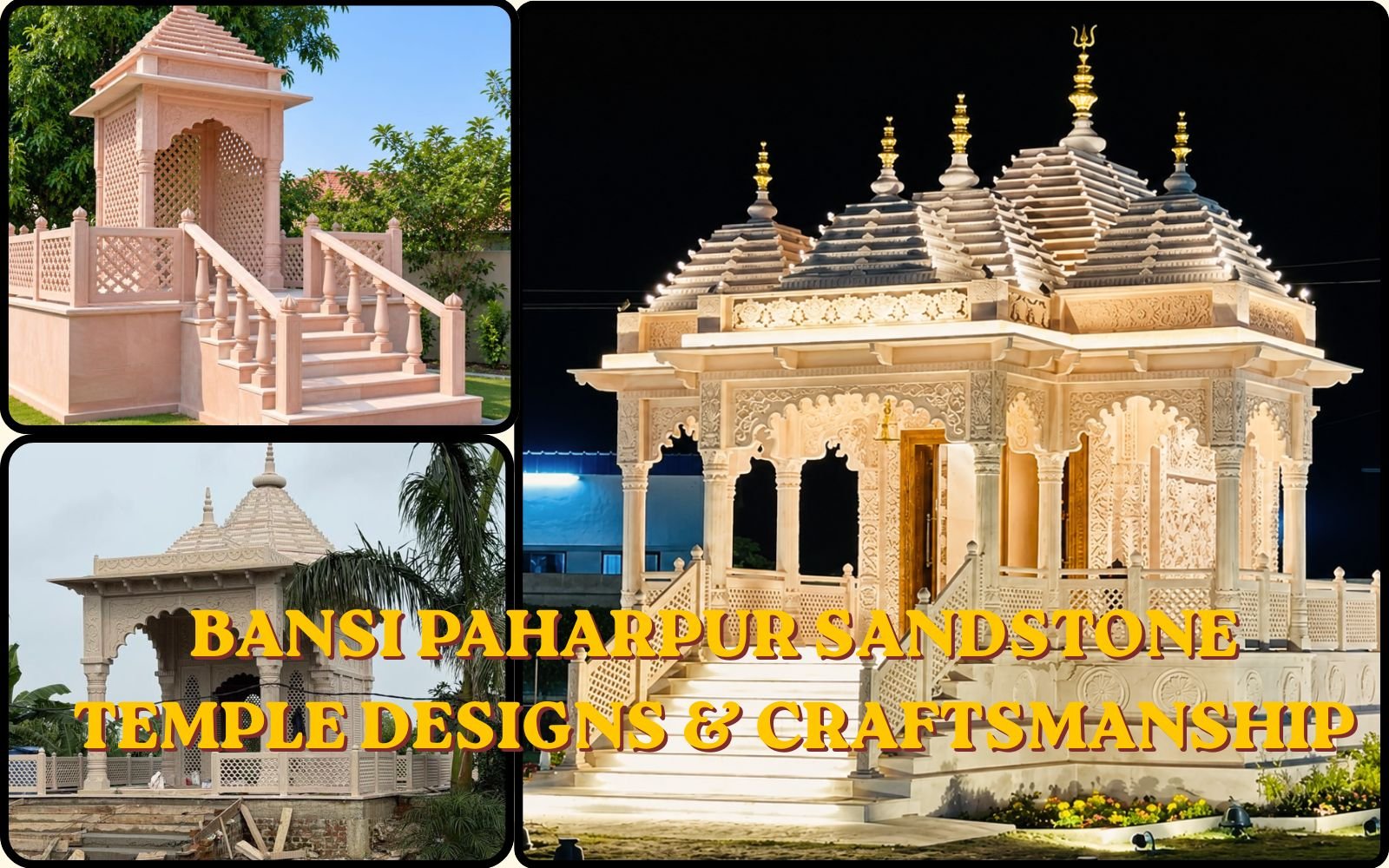
Bansi Paharpur sandstone is a natural sandstone quarried in the Bansi Paharpur area of eastern Rajasthan, known for its pink and red colour variations and its long association with carved architectural work. It is used for temple pillars, jali panels, brackets, facades and other decorative stonework because suitable blocks can be shaped into detailed designs while remaining suitable for outdoor architectural use. This guide explains where the stone comes from, how its colour varies, what properties matter when selecting it, where it is used, and how it is processed for custom sandstone temple projects.
What Is Bansi Paharpur Sandstone?
Bansi Paharpur sandstone is a sedimentary building stone quarried from the Bansi Paharpur region of Rajasthan, part of the wider family of Rajasthan sandstones used in Indian architecture for centuries and valued for its workability combined with natural colour.

Where Does Bansi Paharpur Sandstone Come From?
The stone is extracted from quarries in the Bansi Paharpur area of eastern Rajasthan, within the broader Bharatpur–Dholpur region. Geological records associate these deposits with the Vindhyan sedimentary sequence, and the Paharpur area is specifically associated with Upper Bhander sandstone. For most customers, the practical point is simpler: Bansi Paharpur identifies a specific stone-producing area known for workable, decorative sandstone in pink and red tones.
Why Is It Also Associated With Dholpur Stone?
In the market, Bansi Paharpur sandstone is sometimes discussed using broader regional terms such as Dholpur stone or Bharatpur sandstone. These names can overlap in commercial conversations, but they should not automatically be treated as proof that the material comes from the same quarry. Bansi Paharpur refers specifically to the Bansi Paharpur stone-producing area, so customers should confirm the actual source, colour and material before ordering.
What Does Bansi Paharpur Sandstone Look Like?
Pink Sandstone
Bansi Paharpur pink sandstone ranges from a light, pastel pink to a deeper rose tone, sometimes with faint whitish or reddish streaks. Natural colour can also appear slightly different depending on the individual block, grain and cutting direction, so physical samples are more reliable than photographs when exact colour matching is important. Pure, evenly toned pink blocks are harder to source consistently and can cost more depending on availability.
Red Sandstone
The red variety has a deeper, more traditional colour, occasionally mixed with pink undertones within the same block. Depending on availability and project requirements, red sandstone can be a comparatively economical choice when a deeper traditional colour is preferred.
Natural Colour Variations
Because this is natural stone, colour and grain vary from block to block, depending on the quarry pit, mineral content and cutting direction — this is normal, not a defect. Customers needing close colour consistency across a large project should review physical samples, ideally the actual material set aside for their project, rather than judging colour from photographs alone.
Bansi Paharpur Sandstone Properties
Bansi Paharpur sandstone is a natural architectural sandstone whose physical characteristics can vary between quarry areas and individual blocks. Its suitability for a project depends not only on the stone name but also on the quality of the selected block, its intended use, thickness, design and installation method. Where certified engineering performance is important, properties such as compressive strength and water absorption should be confirmed for the specific material being supplied rather than assumed from the regional name alone.
One of its practical advantages for temple work is its suitability for detailed carving. With an appropriate block and carving method, craftsmen can produce floral motifs, geometric jali, pillar details and other decorative elements while retaining clear edges and surface definition. It is also widely used in exposed settings — courtyards, temple exteriors, garden pavilions and facades — though long-term outdoor performance depends on stone selection, installation, drainage, jointing, local weather exposure, maintenance and suitable surface protection where appropriate, rather than on the stone alone.
What Is Bansi Paharpur Sandstone Used For?


Temple Architecture
Its largest and most recognisable use is temple architecture — pillars, domes, wall panels and entrance frames — since its natural colour and carving potential suit traditional Indian temple design more directly than plain building stones.
Temple Pillars and Panels
Pillars are often the most visually important element of a stone temple, and this material is regularly chosen for carved pillar shafts, capitals and bases, alongside wall panels with floral borders or religious motifs.
Sandstone Jali and Other Architectural Stonework
Sandstone jali — perforated lattice screens — is another classic application; the fine grain allows intricate cut-through patterns that filter light and air while adding decorative character to verandas and boundary walls. Beyond temples, the stone is used for garden pavilions, chhatris, decorative gateways, select facade cladding, and general architectural stonework such as brackets, chajjas and jharokha-style elements.
Why Is Bansi Paharpur Sandstone Used for Temples?
Temple construction usually demands more than a stone that is simply strong enough to build with — it needs to support fine carving, long pillar runs, and dome or shikhara detailing on a building meant to be viewed up close. Bansi Paharpur sandstone fits this because it combines a naturally attractive colour with a grain structure carvers can shape into detailed patterns without unpredictable chipping. It is worth separating structural use from decorative use here: the stone alone does not determine the strength or longevity of a temple. Foundation design, component dimensions, load distribution, jointing, drainage and installation all have an important role in the finished structure, while the stone itself contributes mainly colour, carving capability and a finish associated with traditional Indian temple design.
What Types of Temples Can Be Made from Bansi Paharpur Sandstone?
Home mandirs are a common starting point — compact structures sized for a home courtyard, garden corner or dedicated puja space, often with a simple carved dome and modest pillar detailing. Garden and farmhouse temples are slightly larger, becoming a visual focal point in open landscape, usually with a small veranda and more carving since there is more room to plan foundation and drainage properly.
Community and outdoor temples need to account for visitor movement, a wider courtyard, and multiple entry points, which shapes pillar count and layout differently from a private residential temple. Large temple projects are built component by component — pillars, panels, jali sections, dome pieces and entrance elements are produced separately, checked, and transported for on-site assembly, requiring more detailed design planning and coordinated logistics.
Bansi Paharpur Sandstone Temple Design: What Can Be Customized?
Size and layout are usually the starting point, shaped by available land, the prepared foundation, and the intended use of the space. Pillars and carving — profiles, capital designs and carving depth — can all be adjusted, from cleaner shafts to heavily carved traditional designs. Jali and panels can be geometric, floral or drawn from traditional regional designs, with wall panels carrying carved borders, religious motifs or plain finishes. The dome, shikhara and chhatri details contribute significantly to the temple’s identity and are planned alongside the pillars and panels so proportions read correctly as a finished structure. Final dimensions also need to work with the prepared foundation and the space available for access, transport and installation.
Customers planning this stage can review layout and component options on the company’s Bansi Paharpur sandstone temple page before finalising a design brief.

Bansi Paharpur Sandstone in Indian Temple Architecture
The Bharatpur region, where Bansi Paharpur is located, has a long tradition of pink and red sandstone use in temple and palace architecture, and heritage records for the region document Bansi Paharpur stone in temple architecture there, including carved pillars, wall panels, lattice work and ornamental details. This history is part of why the material continues to be requested by name for new temple projects today.
Bansi Paharpur pink sandstone has also been reported in use for specific elements of contemporary Indian temple projects — for example, reports on the Ayodhya Ram Mandir project describe pink sandstone from the Bansi Paharpur/Bharatpur belt being used for carved figures at the entrance gate area. This should be read as a documented use for a particular element of the project, not as evidence that the entire temple complex was constructed from Bansi Paharpur sandstone; such broad claims about famous monuments should not be assumed without a verified primary source. What keeps the material relevant is less about any single famous building and more a consistent pattern of architects and temple committees returning to it for its recognisable, traditional character.
Bansi Paharpur Sandstone vs Other Rajasthan Sandstones
Bansi Paharpur sandstone sits within the same eastern Rajasthan belt often marketed as Dholpur stone, so the safest approach is to ask specifically for Bansi Paharpur material and request a sample rather than assume any stone sold under the broader label will match. Jodhpur-region stone is a distinct material, generally associated with different natural tones and often chosen for general building construction, exterior cladding and structural work — this does not make it unsuitable for temples, but customers seeking the pink or red carved-temple look typically prefer Bansi Paharpur material for its colour range and carving tradition.
The right choice depends on the visual outcome wanted, budget, and how much carved detail the design calls for. There is no single Rajasthan sandstone that is automatically right for every project; the decision should consider colour, carving requirements, block size, intended exposure, budget and availability. For carved temple work with a pink or red traditional appearance, Bansi Paharpur sandstone is usually the more direct fit.
How to Select Bansi Paharpur Sandstone
Confirm the Stone Source
Ask where the material is sourced from and whether the quoted material is specifically Bansi Paharpur stone, rather than a broader regional label.
Check Colour and Natural Variation
Pink and red sandstone can vary between blocks, so physical samples are preferable to photographs when exact colour matching matters for the project.
Check Block Quality
Visible cracks, unsuitable joints or other block characteristics should be reviewed before a block goes into carving, since these affect how well it holds detail and how it performs outdoors.
Match Stone to the Design
Pillars, jali, panels and heavily carved components can each require suitable block dimensions and selection, so the stone should be chosen with the finished design in mind rather than generically.
Ask About Surface Treatment
Customers should understand whether a protective treatment is being applied to their stone and what maintenance remains necessary afterward.
For Engineering Requirements
Where certified performance is required, request relevant test data for the specific material being supplied instead of relying only on the commercial stone name.
How Rain and Moisture Can Affect Natural Stone
Natural stone is durable, but durability does not mean complete isolation from the environment. Over long periods, sandstone exposed to rain, humidity and airborne dust can develop staining, darkening, mineral deposits or, in damp conditions, biological growth. How quickly this happens depends on local climate, rainfall, drainage and how the stone was installed and finished — there is no fixed timeline that applies to every project. Because these changes are environmental rather than purely age-related, they can often be slowed through good drainage, correct jointing, periodic cleaning, and a suitable surface treatment applied during manufacturing.
How Shri Krishna Stone Company Protects and Manufactures Its Temple Stonework
Stone Selection and Colour Matching
Work typically begins with understanding the customer’s size, design, budget and colour preference — pink or red Bansi Paharpur sandstone — followed by selecting suitable blocks that account for natural colour variation and match the project.
Cutting and Component Preparation
Selected blocks are cut into specific components: pillar shafts, bases, panels, jali frames, dome pieces and entrance elements, prepared for transport and site assembly.
Carving and Detailing
Decorative work uses hand carving and CNC-supported methods depending on the component and design, matched to what the design requires.
Protective Surface Treatment
At Shri Krishna Stone Company, a protective water-resistant coating may be applied to suitable stone components as part of the finishing process. Its purpose is to help reduce moisture penetration and support easier maintenance; it is not presented as making natural stone waterproof or maintenance-free.
Transport and Installation
Once components are checked, they are prepared for transport and moved to the project location, and installation support is provided once the customer’s foundation is ready.
Why Choose Shri Krishna Stone Company for a Bansi Paharpur Sandstone Temple?
Shri Krishna Stone Company, established in 2016 and based in Dausa/Manpur, Rajasthan, under proprietor Mukesh Kumar Saini, manufactures sandstone temples and architectural stonework using Bansi Paharpur pink sandstone and red sandstone. The company has completed more than 100 temple and stone handicraft projects and delivers across 25+ Indian states. The company’s Bansi Paharpur temple work includes custom-built designs such as a 12 × 18 × 23 ft sandstone temple with six carved round pillars and side jali panels.
Rather than one fixed design, temples are built to each customer’s required size, layout and carving level, from small home mandirs to larger component-built projects. The manufacturing process, from stone selection through cutting, carving, checking and transport, reflects practical experience handling natural stone at a component level, and with delivery across 25+ states, the company also supports installation once the customer’s foundation is prepared.
Material Transparency
Natural stone varies from block to block, and customers are informed about the selected colour, the natural variation to expect, and whether a finishing or protective treatment is being applied, along with other production details communicated before manufacturing begins. The goal is to avoid surprises during production or installation. Clear communication helps customers understand what they are paying for and what to expect from natural stone.
Frequently Asked Questions About Bansi Paharpur Sandstone
What is Bansi Paharpur sandstone?
It is a natural sandstone quarried in the Bansi Paharpur area of Rajasthan, known for its pink and red colour variations and long use in carved architectural and temple work.
Where does Bansi Paharpur sandstone come from?
It comes from quarries in the Bansi Paharpur area, part of the wider Bharatpur–Dholpur stone belt in eastern Rajasthan, generally associated with the region’s Vindhyan sandstone sequence.
Is Bansi Paharpur sandstone suitable for temples?
Yes. It is widely used for temple pillars, panels, jali and domes, combining natural pink and red colour with good carving characteristics when suitable-quality material is selected and processed properly.
What colours are available?
Mainly pink and red, each with natural block-to-block variation. Pure, evenly toned pink can be less consistently available and cost more, while red is often more economical.
Is pink sandstone better than red sandstone? Neither colour is inherently stronger or more durable. The choice usually comes down to visual preference, budget and the traditional appearance desired.
Is Bansi Paharpur sandstone waterproof?
No natural sandstone should be treated as completely waterproof. Proper drainage, installation, suitable surface protection and routine maintenance can help reduce moisture-related problems.
Is Bansi Paharpur sandstone expensive?
The cost depends on the colour, block selection, temple size, carving detail, quantity, transport and installation requirements. Pure, evenly toned pink sandstone may cost more than commonly available red or mixed natural tones.
Can Bansi Paharpur sandstone temple designs be customized?
Yes. Size, pillar style, carving depth, jali patterns, panel motifs and dome or shikhara detailing can all be planned according to available space, layout and budget.
Does Shri Krishna Stone Company manufacture temples from Bansi Paharpur sandstone?
Yes. Depending on the project, the process can include stone selection, cutting, carving, suitable surface treatment, transport and installation support across India.
Plan Your Bansi Paharpur Sandstone Temple with Shri Krishna Stone Company
If you are planning a Bansi Paharpur sandstone temple, share your required size, preferred colour, location and design idea with Shri Krishna Stone Company. The team can discuss suitable stone selection, temple components, manufacturing requirements and a project-specific quotation based on what your space and layout actually need.


[…] mainly because it carves cleanly. Go for it if you want a soft, traditional look. Read more on our Bansi Paharpur Sandstone page, or see the Bansi Paharpur Sandstone Temple we […]